
Food Traders: Is Your Food Business Properly Registered?
A timely reminder for market stalls, mobile traders and small food producers
The Food Safety Authority of Ireland reported on 14 July 2026 that 14 Enforcement Orders were served on food businesses during June.
These included 13 Closure Orders and one Prohibition Order. Three of the food businesses named in the announcement were retailers trading from vehicles or stalls at Balbriggan Market in County Dublin.
The reasons identified across the 14 Enforcement Orders included poor hygiene, pest activity, unsuitable food preparation areas, incorrect food storage temperatures, inadequate handwashing facilities, food traceability failures and failure to notify the relevant competent authority about the establishment of a food business.
The FSAI announcement does not attribute each reason to an individual business. However, the inclusion of market-based food businesses makes this a useful reminder for anyone selling food at markets, fairs, festivals and events.
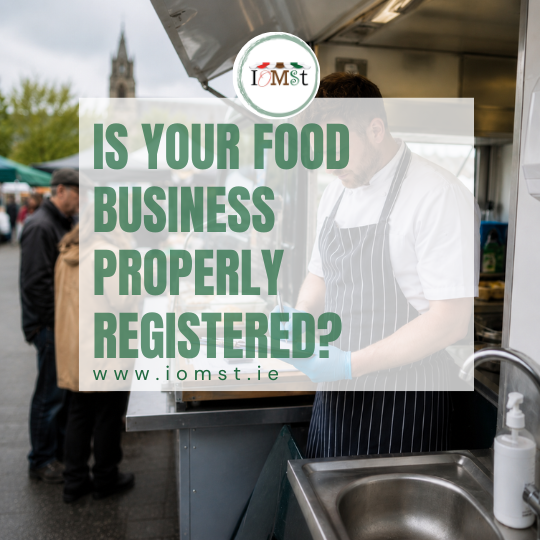
Food businesses must register before trading
Anyone starting a food business must register with, or where required obtain approval from, the appropriate competent authority before beginning to operate.
This requirement is not limited to restaurants, cafés or permanent commercial premises. It can also apply to:
- Food stalls
- Mobile food units
- Food trucks and catering vans
- Market traders
- Retailers selling food
- Food businesses operating from home
- Artisan and small-scale food producers
The HSE states that food businesses must notify it before they begin operating. When submitting a notification, the business must provide details including the type of operator, business contact information, the type of premises being used and the proposed commencement date.
The premises can be a building, stall or vehicle.
Who should you register with?
The correct authority depends on the type of food business and the products being handled or processed.
The HSE typically deals with businesses such as food stalls, mobile food businesses, restaurants, cafés, retailers, delis and some home-based and manufacturing businesses.
The Department of Agriculture, Food and the Marine may be responsible for certain businesses involved in meat, dairy products, eggs and other foods of animal origin.
The Sea-Fisheries Protection Authority may be responsible for businesses handling or processing fish, fishery products and aquaculture products.
Some businesses handling or processing foods of animal origin may need formal approval rather than registration alone. Food traders who are unsure which authority is responsible for their business should seek guidance from the FSAI or the relevant authority before commencing trade.
Registration and insurance are separate requirements
Food-business registration is separate from public liability insurance.
Having public liability insurance does not register a food business with the HSE or another food-safety authority. Similarly, registration with a food authority does not replace the need for insurance where an organiser, landowner, local authority or event requires it.
Traders may therefore need several different documents before attending a market or event, including:
- Evidence of food-business registration or approval
- A suitable food-safety management system
- Food hygiene and allergen procedures
- Public and product liability insurance
- Any casual trading licence or event-specific permission required
The exact requirements will depend on the business, the products being sold and the trading location.
Keep your business information up to date
The HSE’s online notification system can also be used to submit changes to an existing food-business notification.
Traders should consider whether their registered details accurately reflect how and where the business is currently operating, particularly where they have:
- Started using an additional stall, vehicle or premises
- Moved food preparation to a different location
- Changed their business activities
- Begun producing or handling different types of food
- Expanded from occasional trading into regular production or retail
Where there is any uncertainty, the safest approach is to contact the appropriate authority and explain how the business operates.
Do not leave registration until an event application
Market and event organisers may request evidence that a food business has been properly registered or approved. Traders should not wait until an event application is being processed to begin making enquiries.
Registration, food-safety compliance, insurance and permission to trade are separate parts of operating a food business. Each should be addressed before trading begins.
Food traders who are unsure about their registration status can contact the FSAI Advice Line or the HSE National Environmental Health Service for guidance.
This article provides general information and is not a substitute for advice from the FSAI, HSE or another competent food-safety authority.
For more Information, Guides Help, Support or Advice. Get in touch with IOMST and become a member today!
Grainne & Greg
Just a little reminder:
This blog is here to spark ideas and help you think about your business in new ways. What works for one person might not suit another. Take what’s helpful, adapt it to your own style, and if you ever need more tailored advice, just get in touch. That’s what we’re here for, supporting you and your business every step of the way.